Historical Context
Early Lincoln
To understand fully the material deposits of the early residents of Lincoln, the history of the city must be brought into perspective. The Nebraska Territory was first established in 1854, with the city of Omaha as the territorial capital. When Nebraska was considering statehood, the more populous southern region of the territory demanded that the capital be relocated south of the Platte River. Leaders from this area even threatened to seek annexation to Kansas if Omaha remained the capital. To address these demands and prevent potential secession, the legislature ultimately voted to move the capital to Lancaster County, south of the Platte, which would soon be renamed Lincoln. When the village of Lancaster was chosen as the site for the new capital, it was a small town of about 30 residents, situated near salt marshes and salt flats. At the time, there was great optimism that these natural resources would drive rapid economic growth by supporting the development of a salt processing industry.
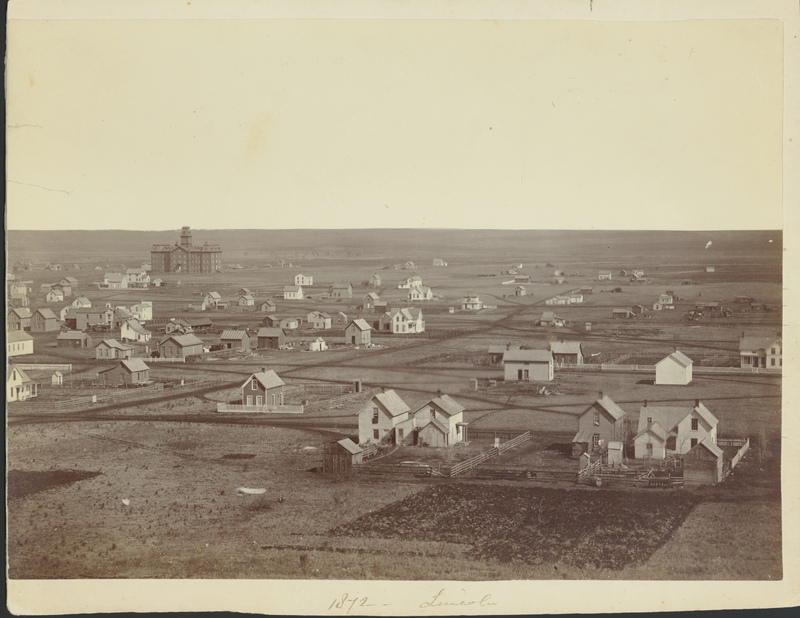
Lincoln underwent significant population expansion in the late 1800s. Its numbers surged from 2,500 residents in 1870 to 13,000 by 1880 and then skyrocketed to 55,000 by 1890.[1] A major driver of this growth was Lincoln’s emergence as a key railway stop for both passenger and freight trains, which brought new residents and a variety of manufactured goods to the city. The completion of the Transcontinental Railroad in 1869 revolutionized American manufacturing by making it possible for companies to access natural resources from far-flung regions nationwide—this laid the groundwork for the Second Industrial Revolution. As a result, manufacturers could create a broader assortment of goods and deliver them to consumers more quickly than ever before. By 1889, three major railroad companies operated through Lincoln, with additional rail lines connecting to these main tracks.[2] This extensive rail network allowed Lincoln to have access to goods from all parts of the country.
The UNL Campus Archaeology collections offer a window into the daily lives of an early Lincoln neighborhood, revealing how its residents organized their homes, the objects they purchased and used day-to-day, and what they ultimately discarded—all preserved in the archaeological record. It is through these artifacts that we can gain insights into the economic, social and domestic life of early Lincoln.[3]
Footnotes
- ^ Zimmer, Edward (2005) “Lincoln-Lancaster County.” Virtual Nebraska. Electronic document, archived from the original: https://web.archive.org/web/20150923224051/http://www.casde.unl.edu/history/counties/lancaster/lincoln/
- ^ Hayes, Arthur Baldey and Samuel D. Cox (1889). History of the City of Lincoln, Nebraska. Lincoln, NE: State Journal Co.
- ^ Athanassopoulos, Effie F., Sara Anderson, Catherine Elliott, Cole Juckette, Amy Neumann, Erik Schultz, Kami Ahrens, and Aaron Pattee (2019). UNL Campus Archaeology: Building Digital Resources. In Cultural Heritage and New Technologies (CHNT) 22, Austria 2017. https://www.chnt.at/wpcontent/uploads/eBook_CHNT22_Athanassopoulos_.pdf