Archaeological Sites
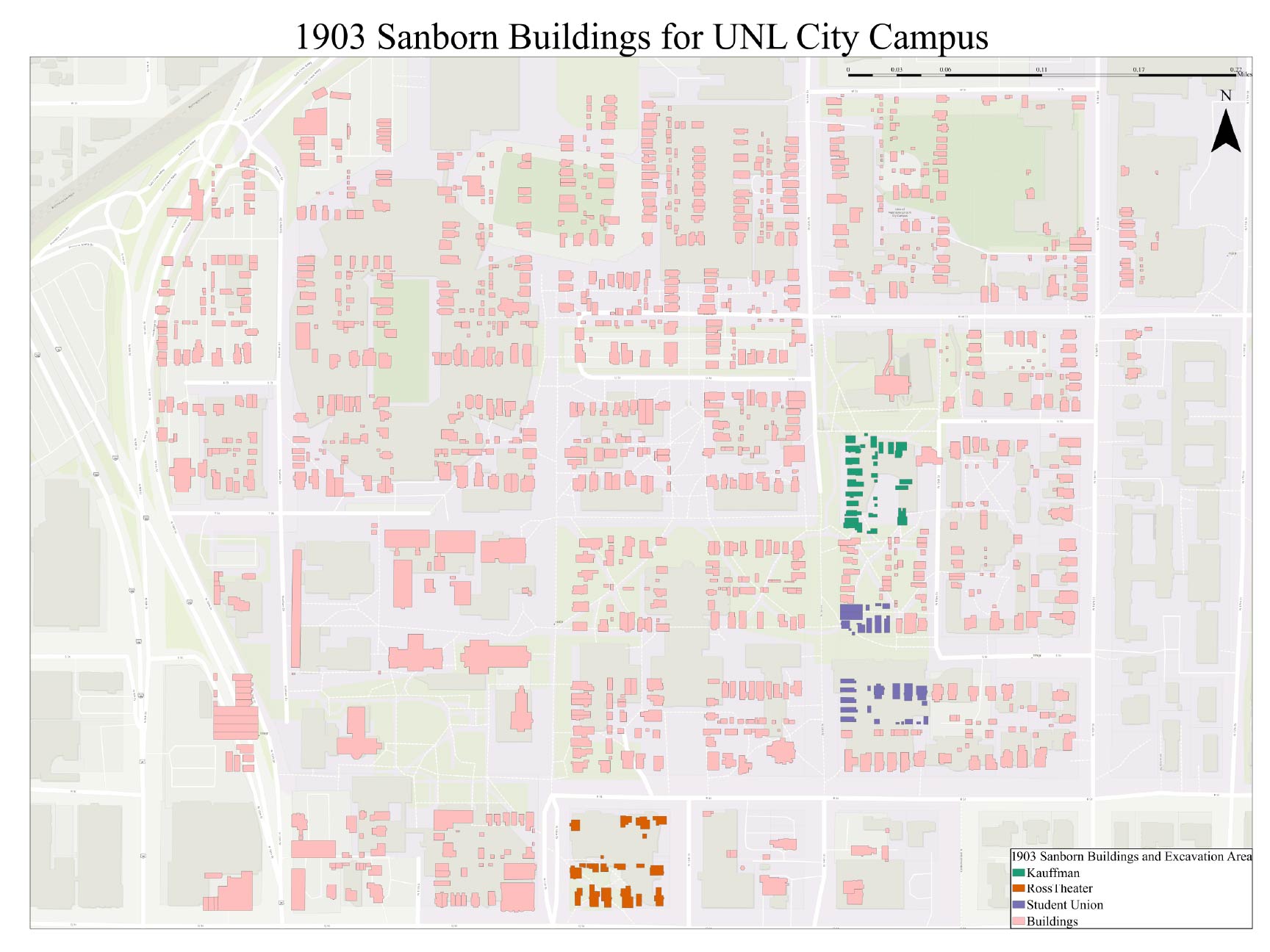
The first UNL campus archaeology site was excavated in May of 1997. A cistern filled with household debris was exposed during the expansion of the University of Nebraska-Lincoln’s Student Union. The historic site (25LC86) associated with the cistern was bordered by 14th Street to the west and R Street to the north. Dr. Peter Bleed, Stan Parks, Stacy Stupka-Burda, and the UNL archaeology field school had a short window of 48 hours to salvage the materials from the site. The top of the feature had been removed by prior construction of the Student Union building between the years 1968–1969, leaving approximately half of the feature untouched. The recovered artifacts include glass bottles, metal artifacts, faunal remains, personal items, and a wide variety of ceramics. Identifiable artifacts indicate that the cistern stopped functioning as a residential water storage system c. 1890 and became a refuse pit.
The Kauffman Dormitory (25LC156) excavation occurred in June 1999. The excavation area was focused on a parking lot that was bounded by 14th Street on the west, 15th Street on the east, and U Street to the north. To the south, it extended approximately three hundred feet, where it met a pedestrian mall. The archaeologist for this project was Michael Chidley, along with Dr. Peter Bleed, Anne Kern, and several volunteers who assisted in the excavation. Because the construction schedule imposed strict time limits and the budget was limited, it was not feasible to conduct a thorough and meticulous excavation. Although nineteen features were uncovered, only fourteen could be excavated in full. Among these features, seventeen were identified as privies.[1] Other notable features included a cistern and a well, both of which were more densely packed with artifacts. Ongoing analysis indicates that the artifacts date from 1875 to 1930, with the majority of diagnostic items falling between 1890 and 1910. [2] Many of these features had been partially destroyed by construction activities during the installation of a parking lot in the 1950s.
Another salvage excavation occurred in June of 2001, when construction began on the Mary Riepma Ross Media Arts Center (Ross Film Theater) on N 13th and R Streets blocks. Within the first month of construction, workers uncovered the remains of two privies (25LC181). They contained an assemblage of historic ceramics, glass bottles, faunal remains, and other discarded material. Over the course of a weekend, an unauthorized person broke into the locked and fenced site and dug straight into the center of at least one of the two privies. Dr. Peter Bleed salvaged what remained of the privy contents, including ceramics and bottles along the periphery of the privy mounds. The precise location of the privies is not well-documented. The structural footprint of the Ross Film Theater occupies the entire eastern half of the block, and thus the privies could have been associated with any of those households that once occupied that portion of the block.
Footnotes
- ^ Chidley, Michael and Peter Bleed. 2003. The Kauffman Dormitory Historical Archaeology Project. A Technical Report on the Archaeological Recovery of 14 Features Prior to the Construction of the Kauffman Residential Center. Department of Anthropology, University of Nebraska Lincoln.
- ^ Neumann, Amy (2018). Life in Lincoln: Deciphering the Archaeological Material Culture of the Turn of the 20th Century Neighborhood. Master’s Thesis, Department of Anthropology, University of Nebraska, Lincoln. https://digitalcommons.unl.edu/anthrotheses/53/